
Understanding Your Locus of Control
‘Locus of control’ is an individual’s belief system about what causes their experiences and how they explain success or failure. It shapes how much control they feel they have over their life, work and results.
In leadership, it’s a powerful lens on why some people take ownership, while others default to blame, luck or “that’s just how it is”.
Listen: Locus of Control on the People Performance Podcast
In this episode, we explore:
What does locus of control mean in real leadership situations?
The difference between an internal and external locus of control
How your language as a leader signals blame or ownership
When an external locus of control can be helpful – and when it keeps teams stuck
Practical ways to shift yourself (and your team) towards healthier ownership
Hit play above, then scroll down to explore the model and take the test.
What is Locus of Control?
The concept of locus of control is usually divided into two types: internal and external.
With an internal locus of control, people attribute success or failure to their own efforts and abilities.
With an external locus of control, people attribute outcomes to factors outside their control, such as luck, fate or other people.
Your locus of control sits on a sliding scale, not a fixed label. You may lean more internal or external overall, but your position can shift depending on the situation, especially around success or failure.
Internal vs External: How It Sounds in Real Life
One of the easiest ways to spot the locus of control is through the language people use.
Internal locus of control, typical phrases:
“I know it’s my responsibility.”
“I need to develop myself to succeed.”
“We really knocked it out of the park there, well done.”
People with an internal locus of control tend to talk in the first person and see themselves as responsible for their results.
External locus of control, typical phrases:
“If it wasn’t for them, I’d be much higher up the ladder.”
“They were lucky, right place, right time.”
“It’s tough in our market; the competition is killing us.”
Here, success and failure are often explained by fate, luck, other people or circumstances, rather than personal effort.
Key Characteristics: Internal vs External
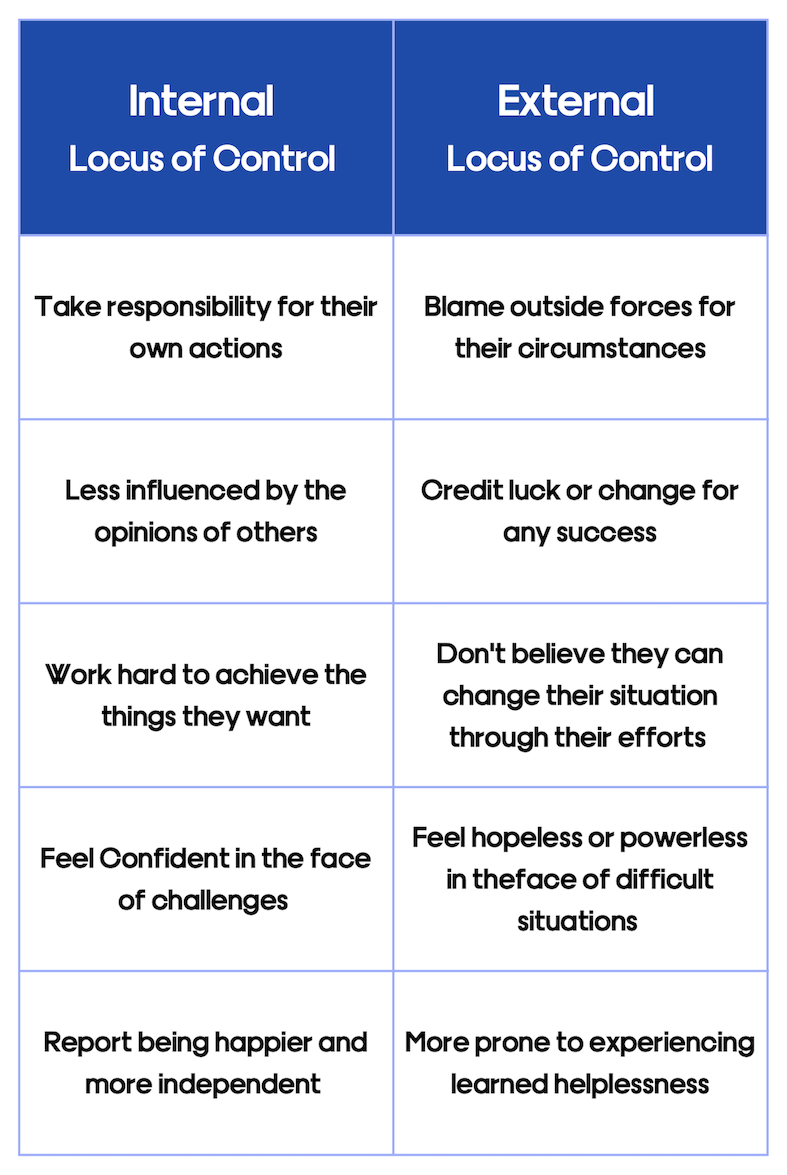
People with a more internal locus of control tend to take responsibility, feel more confident facing challenges and report greater independence and happiness.
People with a more external locus of control are more likely to feel powerless, blame outside forces, and experience learned helplessness when things are difficult.
Is One Better Than the Other?
Research suggests that people with a stronger internal locus of control are often “better off”. When you feel you can influence your performance, decisions and outcomes, you’re more likely to take action and stay in a healthier psychological place.
However, an external locus of control isn’t always negative. In some situations, temporarily attributing a setback to external factors can protect self‑esteem and stop people from harsh, unhelpful self‑criticism. The key is balance, recognising what is truly in your control, and what isn’t.
Do you tend to lean more internal or external?
This short test will help you understand where you sit on the scale and give you a starting point for reflection and change.
Why This Matters for Your Leadership
Your locus of control influences how you show up as a leader, how you respond to setbacks, how you talk about success, and what your team learns from watching you.
If you go mostly external, your team may learn to blame circumstances instead of owning solutions.
If you have a healthy internal locus of control, you’re more likely to take accountability, build trust and encourage others to take ownership too.
Think about a recent success and a recent setback. How did you explain each one – mostly internal or mostly external? What did your team hear in the way you described it?