
Purpose, presence and perseverance: Leadership lessons from Rich Diviney
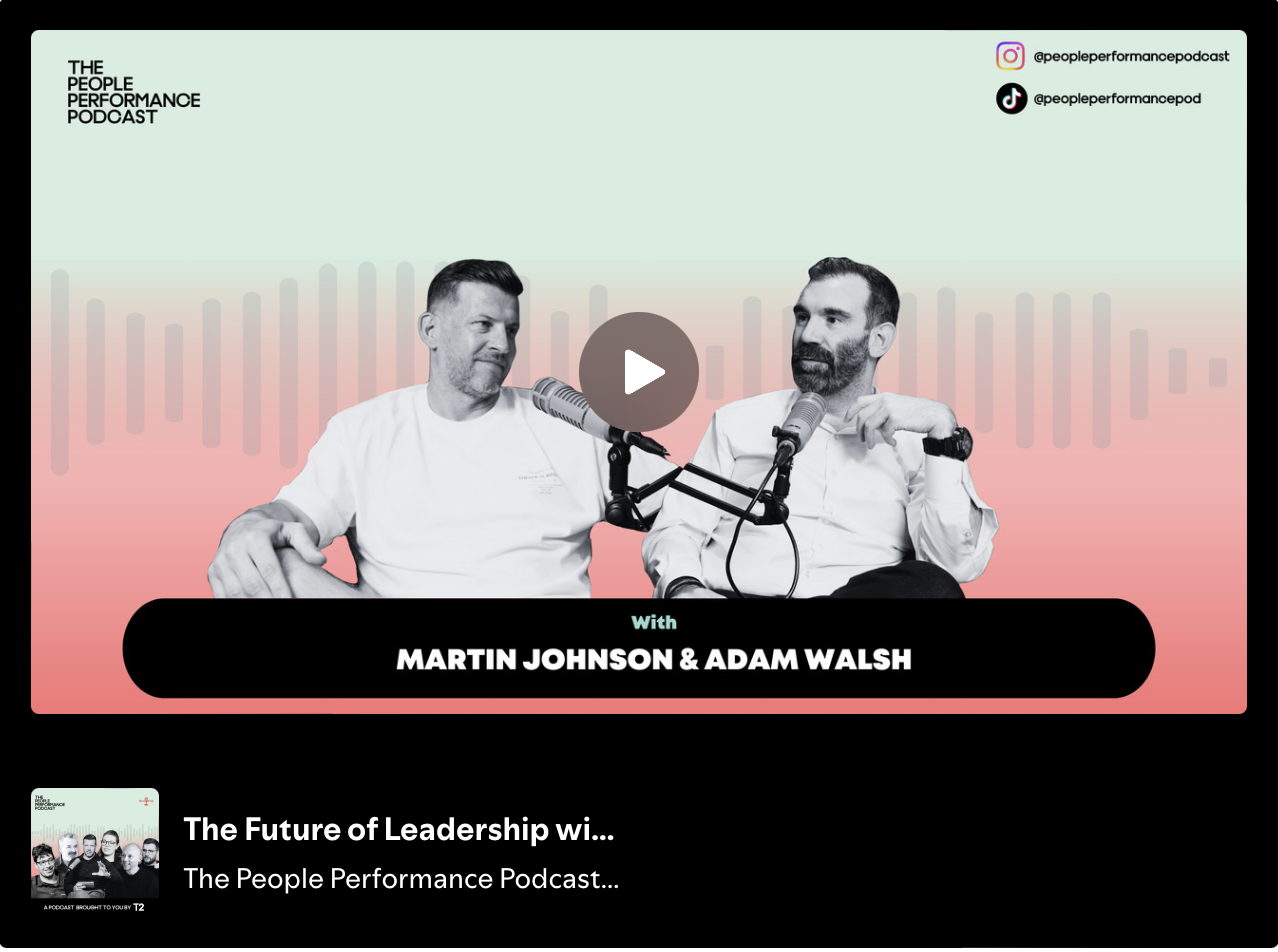
In the latest episode of The People Performance Podcast, our founder and CEO, Martin Johnson, sat down with Rich Diviney – a former Navy SEAL commander with over 20 years of military service and the author of The Attributes and the newly released Masters of Uncertainty. What emerged from their conversation were powerful insights about how leaders can navigate uncertain environments, build genuine trust, and shift from pursuing peak performance to embracing optimal performance.
Pick your horizon when uncertainty looms
Rich introduces a concept that every leader facing overwhelm should understand: moving horizons. The principle is deceptively simple but profoundly effective.
“When we pick a horizon, what we’re doing is we’re actually initiating a dopamine burst that is going to allow us to get moving,” Rich explained. “If it’s too far, you’re going to run out of dopamine before you get there. You’re going to quit. If it’s too close, you won’t feel a registered reward.”
Rich recalls being in Navy SEAL training during Hell Week, running with heavy boats on his head for hours with no end in sight. At 3 am on the beach, he made a critical decision: “I’m just going to focus on getting to the end of the sand berm.” By picking the horizon, he created what he calls DPO – duration, pathway, and outcome.
Our brains are constantly trying to figure out three things in any environment: how long this will last (duration), what’s the route through (pathway), and what’s the end state (outcome). When we’re absent for one or more of these factors, uncertainty rises and our autonomic nervous system kicks in.
For leaders, this translates directly to managing overwhelming workloads or complex projects. Don’t focus on the entirety of everything that needs doing. Pick your next immediate horizon – the next five emails, the next client meeting, getting to Friday. Create your own DPO, move to it, register the reward, and pick a new horizon.
As Martin observed, “If I look at my whole diary and my commitments, it’s really overwhelming. But if I say, right, if I just sprint to 9th December, by the time I get there, I’ve got a three-day breather.” That’s moving horizons in practice.
Understand that worry is fiction
One of Rich’s most striking insights challenges how we think about anxiety in the workplace. “Anxiety is completely internal,” he explained. “And one of the things we have to understand about anxiety is that anxiety is, in fact, fiction. It’s always ahead of us. It’s always the future. And the future is always fiction.”
Rich distinguishes between proper planning and worry: “Planning is different than worrying about something. Worrying is like I’ve done what I’m going to do, and I’m just worried. It’s a very frenetic use of energy.”
This reframing is crucial for leaders. How much time do teams waste worrying about scenarios that haven’t happened yet and may never happen? How much energy is expended on hypotheticals rather than execution?
Rich’s approach, learned in the Navy SEALs, is straightforward: “We don’t worry about that which we can’t control. We don’t concern ourselves with things and fictions that don’t exist yet.” This doesn’t mean ignoring risk or failing to prepare. It means focusing energy on what you can actually influence in the present moment.
For leaders, the challenge is creating cultures where teams plan appropriately for contingencies without spiralling into paralysing worry about every possible future scenario. The difference matters enormously for both wellbeing and performance.
Pursue optimal performance, not peak performance
Perhaps the most liberating insight from the conversation is Rich’s distinction between peak performance and optimal performance, a philosophy he shares with Martin and the team at T2.
“Our lives are always going to be wrought with uncertainty, challenge and stress,” Rich explained. “We can’t be peak all the time. And being peak all the time, if you could be peak all the time, you’d run out of energy.”
Rich describes optimal performance as an umbrella underneath which peak performance lives, but also where “gutting it out” lives, and even recovery lives. The highest performers are constantly modulating themselves inside that umbrella, matching their energy state to what the moment requires.
He gives a striking example: “We’d be in helicopters flying into combat and the guys around me would be napping. We don’t know what’s coming. We don’t know how long we’re going to be out there. We’re not going to waste an ounce of our energy doing things we don’t need to do.”
For business leaders, this challenges the relentless pursuit of peak performance that social media and business culture often promotes. As Martin observed: “We live in a world where it’s peak performance this, high performance that, elite this. And it’s becoming quite overwhelming because people’s lives don’t feel like that.”
The reality is that high-performing teams and individuals deliver results not just when things are going great, but when things fall apart – when it’s ugly, gritty, and hard. That’s optimal performance: doing the best you can, in the time you’re given, with the resources at your disposal.
Build trust on four foundations
When discussing high-performing teams, Rich introduced his four C’s of trust: Competence, Consistency, Character, and Compassion. While similar to T2’s trust equation (Credibility + Reliability + Rapport), Rich’s model adds nuance that matters for leaders.
“The reason the four elements become interesting is because you can actually build or begin to build a trusting environment inside of any one of those four things,” Rich explained. “It’s only when you have all four that you have the longest lasting, most durable trust.”
Rich illustrated this with a powerful analogy. If you call a cab and the driver crashes into a telephone pole, you won’t get back in with that same driver again. You only had two elements of trust – consistency of the cab company and perceived competence of the driver. When competence broke, trust evaporated.
But if your best friend picks you up, crashes into a pole, and a few days later offers you another lift, you’ll probably get back in the car. Why? Because you have all four elements. When one takes a hit, you have others to fall back on.
For leaders, this means understanding that trust isn’t binary. It’s multidimensional. And critically, as Rich emphasises: “If you want to be a leader, you have to go first. You won’t actually be a leader if you wait for others to prove themselves worthy of your trust first.”
Leaders must model competence, demonstrate consistency, show character through integrity, and display genuine compassion. Only then can they expect teams to reciprocate.
You also might like…